
Centre of excellence
Minimal Invasive Surgery
Smaller cuts, shorter stay, faster return to normal
In short
Minimal access surgery at Sreshta Multi Speciality Hospitals covers laparoscopic and robotic assisted procedures across general surgery, gynecology, urology and surgical oncology. Operating through ports of five to ten millimetres means less blood loss, less pain after surgery and a hospital stay measured in days rather than weeks.
The difference between keyhole and open surgery is not really about the scar. It is about what happens in the two weeks afterwards. Open surgery cuts through the muscle wall, and that wall takes time to heal whatever else you do. Keyhole surgery goes between the muscle fibres through small ports, so there is far less to recover from.
Four of our surgeons hold formal minimal access qualifications, including fellowships from the International College of Robotic Surgeons and the World Association of Laparoscopic Surgeons. That matters because laparoscopy is a skill, not a machine. The equipment is the easy part to buy.
What we treat
Conditions seen in this department
- Gallstones and gallbladder disease
- Hernia of all types
- Appendicitis
- Fibroids, ovarian cysts and endometriosis
- Kidney and ureteric stones
- Colorectal disease including cancer
- Unexplained abdominal and pelvic pain
Treatments offered
Procedures we perform here
What each one involves is explained to you before anything is scheduled, along with what it costs and what the recovery looks like.
Laparoscopic cholecystectomy
The most common keyhole operation we perform
Laparoscopic hernia repair
TAPP and TEP approaches
Laparoscopic hysterectomy and myomectomy
Uterus removed or fibroids removed, uterus kept
Diagnostic laparoscopy
To find the cause when scans are inconclusive
Robotic assisted procedures
For colorectal, urological and oncological work
01
Ports, not incisions
Most procedures are done through three or four openings of five to ten millimetres. The scars fade to almost nothing within a year.
02
Home in one to two days
Shorter admission means lower cost, less time off work and a much lower risk of hospital acquired infection.
03
Fellowship trained team
FMAS, DMAS, FIGIES, WALS and an International College of Robotic Surgeons fellowship are held across the surgical team.
Your consultant
Consultants in this department
 General & Laser SurgeonMBBS, MS (General Surgery), FISCP, D.MAS
Dr. K. Aravind Sagar
 Obstetrician & GynecologistMBBS, MS (OBGY), D.MAS, F.ART, Diploma in Cosmetic Gynaecology
Dr. Spandana Nalagandla
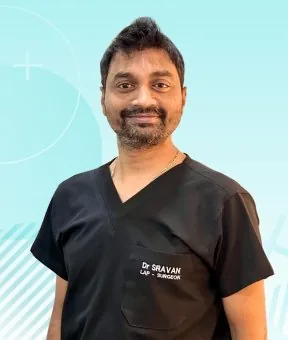 Coloproctologist & Laparoscopic SurgeonMBBS, MS (General Surgery), FMAS, FISCP, DMAS, FIGIES, WALS, Fellowship in International College of Robotic Surgeons
Dr. K. Sravan Kumar
 Surgical OncologistMS, FMAS, DrNB (Surgical Oncology)
Dr. Harish Dara
Questions
Minimal Invasive Surgery, answered
It suits most patients, but not all. Extensive adhesions from previous surgery, certain heart and lung conditions, and some emergencies are safer handled open. Your surgeon assesses this before the operation and will tell you if open surgery is the better choice.
The procedure itself can cost a little more because of the instruments used. The total often works out similar or lower once the shorter hospital stay, fewer dressings and earlier return to work are counted.
Both are keyhole techniques. In laparoscopy the surgeon holds the instruments directly. In robotic assisted surgery the surgeon controls instruments through a console, which gives finer movement and better vision in tight spaces such as the pelvis.
We are here
Consult our minimal invasive surgery team
Call the front desk and we will book you with the right consultant. Bring any previous reports, scans and medication you are on.
Emergency and ambulance, 24 hours+91 99988 86128